










|
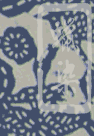
The term “Blue Nankeen” describes a hand-woven and hand-printed fabric of artistic refinement and primitive simplicity, which originated on the legendary Silk Road over three thousand years ago. While the courts and urban dwellers used silks in their clothing and accoutrements, those living in the countryside dressed more simply, using the white cottons dyed with blue pigments.
In this process, pure cotton is dyed with the distilled color of local grasses, most commonly the blue of the indigo plant, cultivated in China since the Zhou dynasty (1027 to 221 BC). Patterns are then introduced by the “paste resist method”, an art developed during the Song dynasty (960 to 1279 AD). Stencils, originally made from wood but now from heavy paper, are prepared and a mix of soya bean flour and slaked lime applied through the openings onto the fabric, which is then dipped in large tubs containing the indigo dye. When dry, the paste is scraped off, revealing the white patterns on blue cloth. The fabric is then washed, dried and ironed before it is delivered to the workroom where it will be fashioned into accessory, clothing and household items. The finished fabric is reputed to have medicinal qualities, warding off insects and addressing respiratory problems and other health issues. Such fabric represents a fast-disappearing historic art form which embodies ancient Chinese culture and traditions. The dyeing houses which provided the Blue Nankeen fabric are disappearing from the countryside, with the result that these artisan-produced fabrics are in need of immediate preservation, lest they be lost forever. Tiverton Trading Company supports “blue and white for life”. |
||










